


Nassim Nicholas Taleb’s Fooled by Randomness argues that humans systematically misattribute success to skill when luck plays a far greater role than anyone wants to admit, particularly in finance.
Written before “The Black Swan” made him famous, this earlier work lays the foundation for Taleb’s lifelong obsession with randomness, probability, and our flawed intuitions about chance.
Taleb opens with a thought experiment that haunts the entire book: imagine 10,000 investment managers, each with a 50% chance of making money in any given year purely by chance. After five years, mathematics dictates that some 313 managers will have shown consecutive profitable years through pure luck alone. The financial media will celebrate these survivors as geniuses, write profiles about their unique methods, and ignore that their success was statistically inevitable given enough participants—identical to flipping coins until someone gets five heads in a row.
The author introduces his most famous character: a fictional trader named Nero Tulip, used to illustrate the difference between rare, careful traders who avoid blowups and flashy traders who appear successful until catastrophic losses erase years of apparent gains. Taleb contrasts this with a real example from his own trading career—a colleague who made consistent profits for years through high-risk strategies, was celebrated as brilliant, then lost everything in a single market event that his models deemed nearly impossible. The colleague hadn’t been skilled; he’d been collecting small, consistent payouts while accumulating invisible risk that eventually exploded.
Taleb introduces the concept of “alternative histories”—the parallel universes that could have unfolded but didn’t. He argues that judging decisions solely by outcomes ignores how easily things could have gone differently. A reckless driver who arrives home safely made a bad decision with a good outcome; we shouldn’t confuse the two. Similarly, traders who took absurd risks and happened to profit aren’t skilled—they’re lucky, and examining only the realized outcome while ignoring probable alternative outcomes creates dangerous overconfidence in flawed strategies.
The book explores “survivorship bias” through Taleb’s dentist analogy: if you only see successful businesses, restaurants, or investment funds, you develop a skewed view of what strategies actually work. The vast graveyard of failed ventures using identical strategies remains invisible, creating false confidence in approaches that were actually just lucky variations that happened to survive selection pressure, not necessarily smart bets.
Taleb shares his own psychological struggles with randomness despite his statistical expertise. He admits to feeling genuine anger when a colleague who took foolish risks made money, even though intellectually he understood this proved nothing about skill. He describes deliberately avoiding financial news and market commentary, recognizing that constant exposure to random short-term fluctuations creates emotional reactions disconnected from genuine information, tricking even sophisticated investors into seeing patterns in noise.
The author examines how our brains evolved to detect patterns, even when patterns don’t exist—a tendency he calls being “fooled by randomness.” He describes an experiment where he generated random walks (literally simulated using coin flips) that looked remarkably like real stock charts. When shown these alongside actual market data, even experienced traders couldn’t reliably distinguish authentic price movements from pure randomness, yet they confidently explained the “patterns” they perceived in both.
Taleb addresses the asymmetry between rare, catastrophic events and frequent, small gains. He describes strategies that generate steady small profits for years while harboring hidden risk of catastrophic loss—what he calls “picking up pennies in front of a steamroller.” Such strategies look brilliant during calm periods, attracting capital and praise, right until the steamroller arrives and erases years of apparent gains in a single event that probability models deemed nearly impossible.
Taleb concludes that wisdom requires accepting irreducible uncertainty rather than constructing false narratives of skill and control. He advocates for strategies that survive randomness rather than ones that merely profit from it temporarily—building resilience against rare disasters rather than optimizing for frequent small gains that mask catastrophic tail risk. Fooled by Randomness ultimately challenges readers to distinguish between genuine skill and statistical noise, arguing that true wisdom lies in humility about what we don’t know rather than confidence in patterns that may be nothing more than the inevitable byproduct of chance operating across thousands of random trials.
Get the book here : USA | UK | India or get this audiobook for FREE on Audible.
From our Archives - by the same author
Antifragile by Nassim Nicholas Taleb
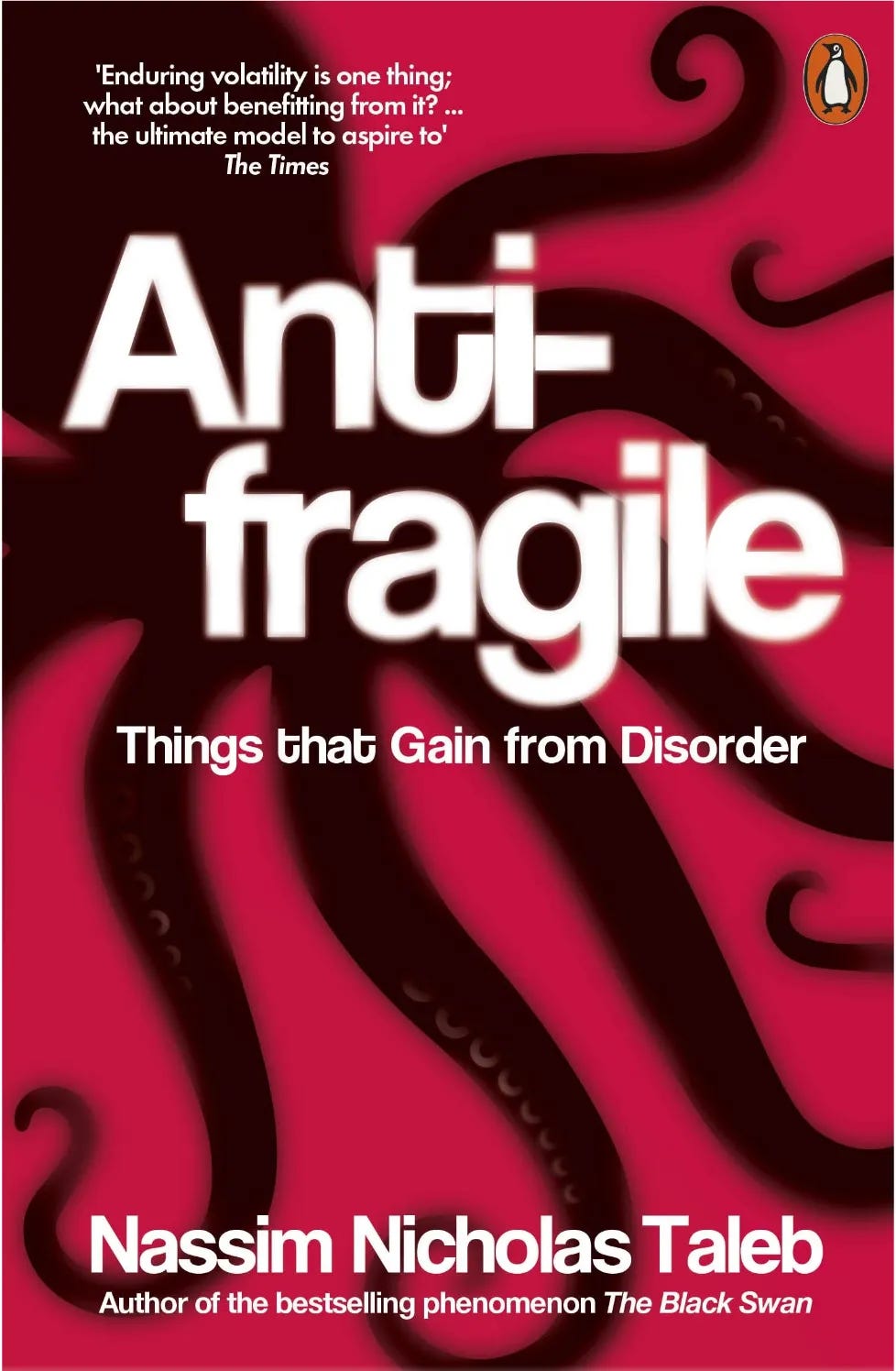
Antifragile is a book by Nassim Taleb that introduces a new word - antifragile. But what does it mean? Imagine dropping a glass - it breaks. The glass is fragile. Now, think of a rubber ball. If you drop it, it just bounces back. That’s resilience. But what if there was something that actually got better every time you dropped it? That’s antifragile.
Taleb takes this idea all over - from economics to your daily life. He says our world tries to hide from randomness. We build models, make plans. But in doing so, we’re setting ourselves up for a fall. We’re like a glass, not even a rubber ball.
He suggests a different way. Embrace the chaos. Don’t fear the unknown. Imagine if a fall could make us stronger, not weaker. For example, think of a workout. It’s tough, it hurts. But over time, it makes us stronger. That’s antifragility in action.
In Antifragile, Taleb invites us to become like the mythical Hydra. When one head is cut off, two grow back. Not only surviving chaos, but thriving in it. It’s a book that challenges how you see the world and your place in it.